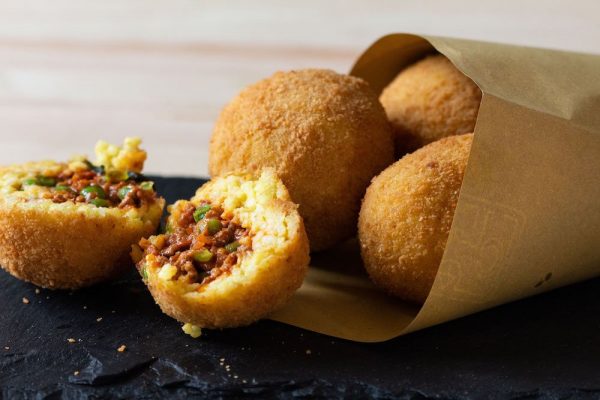
That Walking Risotto called: Arancina
In Sicily, on December 13th is Saint Lucia’s Day —Santa Lucia–, a major food holiday where Sicilians traditionally eat arancina —or plural arancine— instead of pasta and bread, due to a miracle legend from a 1646 famine when a ship of grain saved Siracusa —located on the south-east district of Sicily–, leading to boiled wheat and rice foods being eaten to honor the saint.
Sicilian Bakeries’s core business for December 13th have focus on selling Arancine, Potatoes Gateaux or the sweet Cuccia .–a cooked grain served with sheep ricotta-cheese, cinnamon, candied fruit and chocolate— as well as all the traditional dishes for this special fiest excluding, this day, bread and pasta that for the 13th are not allowed.
What is the origin of Arancine?
Originated in Sicily in the 10th century during Arab rule who use to served the rice in a large bowl of saffron-infused with plates of meat and vegetables shared between a table. The arancina —as it appears now— was born from the need to transform an originally Arab’s food into a practical, portable, economical, nutritious and tasty food, easy to eat while walking through the city streets and which perfectly embodies the soul of popular cuisine and the cultural identity of Sicily and our world-famous Street Foods.
 CURIOSITY
Do not feel confused if on the web you will find the words: ARANCINA —feminine name— and ARANCINO —masculine name–.
Which are the differences and, why people from Palermo —west side— and Catania —east side–call this delicious dish, 100% Sicilian, in similar but different name?
The friendly-conflict between arancina and arancino is a famous Sicilian debate over the gender of the fried rice ball, reflecting regional identity: Western Sicily –Palermo– uses arancina –feminine, like the fruit arancia– for round shapes, while Eastern Sicily –Catania– uses arancino –masculine, like the tree arancio, or for cone shapes like Mt. Etna–.
Both forms are considered correct by Italy’s Accademia della Crusca —language academy–, acknowledging regional usage, but the choice often signifies one’s origin and preference for the round or conical shape.
Trust me guys, if you have the chance to visit the island of Sicily, eat both in the two different area of Sicily.
Both are delicious, a little bit different each other for the form and the ingredients, BUT this is a secret. I am from Palermo where the Arancine are female, so do not say to people in Catania that I do appreciate also their masculine-Arancino!!!
WHERE YOU CAN ENJOY ARANCINE TASTINGS OR ARACINE COOKING CLASS?
In Sicily and especially while in Palermo and Catania. You can find a list of different solutions surfing into our Booking HUB> or be in touch with us to bespoke your experience in Sicily!
Ciao for now, Valeria –nick-name: Valy–